Journaling a Thunderstorm: Capturing Light, Sound, and Smell in Words
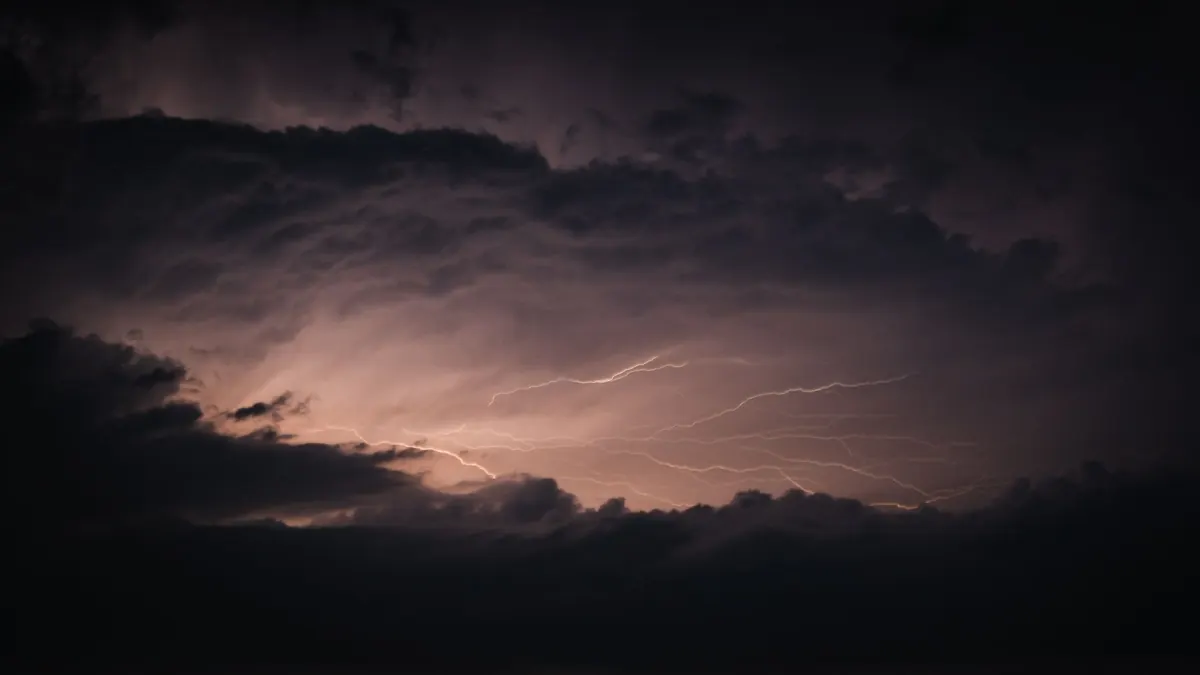
Thunderstorms give you perhaps forty minutes of the best material nature hands out all month, and most of it slips past while you are deciding whether to close the windows. The fix is simple: stop watching and start recording. Not as a meteorologist logging data, but as a writer choosing one honest detail per sense, again and again, until the rain stops.
You do not need storm-chasing habits. A porch, a kitchen window, and a notebook that tolerates damp will do. What you need is a plan for the three phases — approach, peak, passing — because each one asks something different of your attention.
Before the First Rumble
The approach is the longest phase and the easiest to miss, since nothing dramatic has happened yet. Watch for the changeover rather than the spectacle. The wind swings around and picks up; the temperature drops several degrees in a minute; birds go quiet; the light turns a flat yellow-grey that makes green fields look overexposed.
Then shapes arrive. A cloud base darkens from the bottom up, the anvil spreads wide and flat at the top, and a rain shaft appears as a grey curtain hanging under the cloud, miles away and clearly moving. This is your richest stretch for notes, and you will fill it best by timestamping short lines down the margin as they occur.
4:06 — wind from the northwest, dust lifting off the lane. Leaves flipped, silver undersides.
4:11 — temperature down. Birds gone. Sky bruised plum over the ridge, still blue behind me.
Two lines per timestamp is plenty. Write in the present tense while it is happening; polish later, or not at all.
Sound Is the Hardest Sense to Write
English gives you four words for thunder: rumble, crack, boom, roll. That is the whole toolbox. So stop hunting for adjectives and take the sound apart instead. Note the attack — how it begins, a tear, a slap, a single dry snap. Note the body, the loud middle, whether it is flat and close or padded by distance. Note the tail, how it ends, in a grumble, a cough, or nothing.
The pauses between strikes matter as much as the strikes. A long silence after a bright flash is information: the storm is far off and you have time. Write down the quiet, and the page starts to breathe.
Count the Seconds
Sound travels roughly one mile every five seconds. Count from the flash to the first thunder, then divide by five for miles, or by three for kilometres. Writing “eleven seconds — a little over two miles out” beats ten adjectives, and it gives you a record of the storm closing in. Rolling thunder is partly the length of the lightning channel and partly echoes off hills and cloud, so a note like “long roll off the far ridge” tells you something a single word cannot.
Smell, Air, and Skin
Smell is where most storm journals go thin, yet it is the sense readers remember. The first drops on dry ground release petrichor, that dusty-green scent made of plant oils and compounds from soil bacteria. Before the rain, you may catch a sharp metallic note people call ozone; after lightning, sometimes again. Wet asphalt, hot dust, crushed leaves, and the sudden smell of cold stone all belong on the page.
Do not forget touch. Humidity thickening on your arms, the first cool gust on the back of your neck, the pressure that makes your ears feel packed, the sting of a single heavy drop. When these are written alongside the visual, the storm stops being a picture and becomes weather.
At the Peak, Write Fragments
When the storm is overhead, your job is not composition. It is capture. Shelter first — indoors or in a vehicle, away from windows and metal — and then jot fragments in whatever order they arrive, because the peak of a storm is not the time for sentences.
- Rhythm: a hiss on grass, a drum on the roof, a roar in the gutters. Note which surface is speaking.
- Light: green-grey gloom, then a flash that turns every window into a mirror.
- Wind: which way the rain is falling, and whether it has switched mid-storm.
- Water: the drip line off the eaves, puddles jumping, hail knocking on the glass.
- Body: the pressure behind your ears, the sound you feel in your chest.
Single words are fine here. “Hail, pea-sized, six seconds” is a complete entry. You can build it into a paragraph tomorrow, when your hands are steady and the desk is dry.
The Passing Is Where the Best Writing Lives
Most journals stop when the rain does. That is a mistake. The retreat of a storm is quiet and full of detail: dripping eaves, the far mutter of thunder losing its edge, steam lifting off hot asphalt, the smell of wet bark, birds testing the air one call at a time.
Note the return of the light especially. After a storm, sun often comes in sideways under the cloud deck, and colour returns with a clarity you have not seen for an hour. Write down how fast the temperature climbs back, and where the storm went — a pale curtain over the far ridge, a dark line on the horizon, gone. That last line of the sequence is what makes the whole storm feel large.
The Edit You Do the Next Morning
Raw notes are raw on purpose. The next morning, ten minutes of shaping turns them into something you will reread. Work in this order:
- Read the notes aloud. Clumsy phrases announce themselves.
- Cut adjectives that do no work: ominous, majestic, angry, fierce.
- Keep verbs and nouns. “Hail drummed” survives; “the sky was frightening” does not.
- Limit yourself to one image per sense per page. Choose the best and delete the rest.
- Remove anything you did not actually observe. Reconstructed detail reads false.
- Keep the one line that surprised you, even if it fits badly. That line is usually the page.
A fair copy written the next day also preserves the timestamps, which is what turns a set of impressions into a record you can compare across seasons.
A Storm Page You Will Actually Fill
Make it easy on yourself. Keep a standing template at the top of a page: date, place, weather at the start, wind direction, then three columns — time, what I saw, what I heard — and a final line for “the smell of it” and one sentence you would keep if you could keep only one.
Practice on small weather. A drizzle front, a passing shower, a gusty evening will teach the habit without the pressure of a real storm. When the big one arrives, the page is already open.
One safety note, stated plainly: lightning is dangerous, and a notebook is not worth standing in a doorway for. Note what you can from shelter, and let the storm have the sky to itself.
Do this a few times a season and you will end up with something rare — not weather data, not poetry, but an honest record of what a particular afternoon felt like from the inside, in light, sound, and smell.
Photo: R.O.Y / Pexels