Winter Tree ID Without Leaves: A Beginner's Bark and Bud Guide
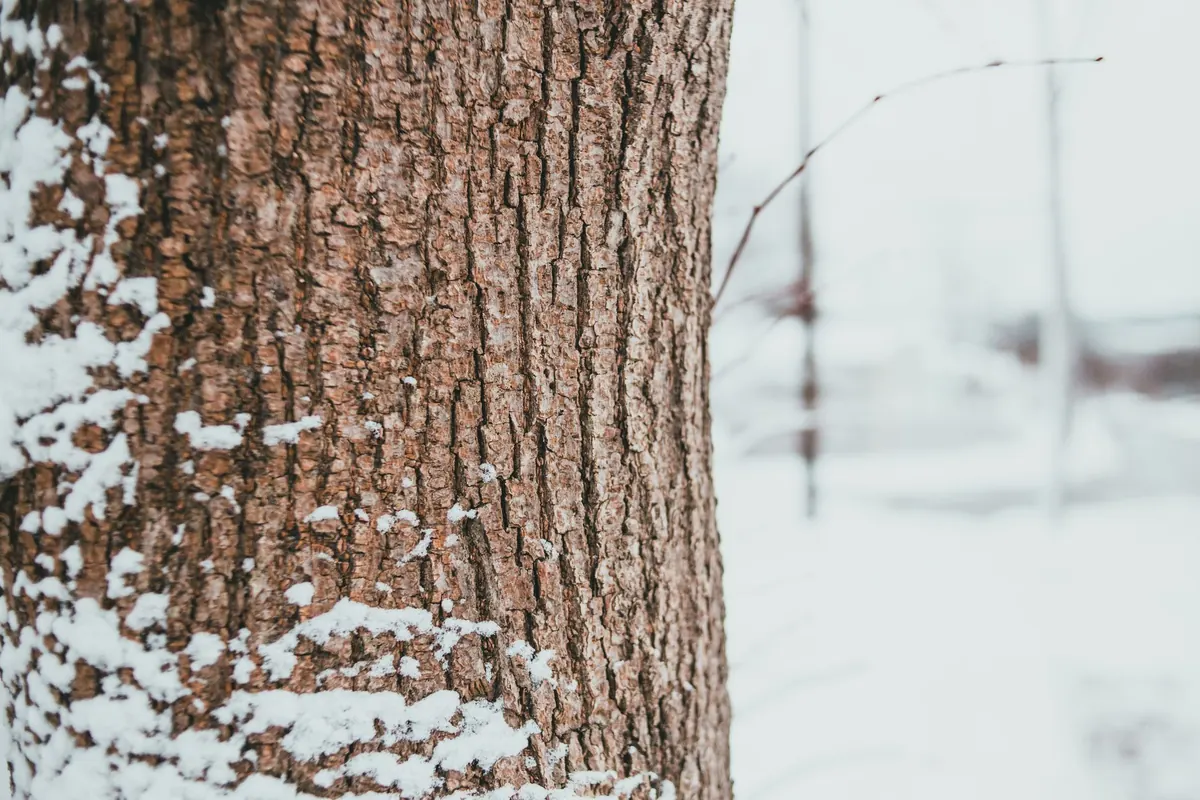
By February, the trees along my usual trail look like the same gray sketch repeated at different sizes. Then something shifts, and one trunk turns out to be furrowed like a washboard while another is smooth enough to reflect a low sun. The bare landscape starts sorting itself out.
Winter identification isn't harder than summer identification. It just asks you to look at different parts of the tree. Bark gets nearly all the attention, and it's the least reliable clue on its own. Buds, twigs, and overall shape tell a more honest story. Combine three or four features and you can name most common deciduous trees in January with confidence.
Start with how the buds are arranged
Find a twig near the end of a branch, where this year's growth is. Are the buds and side branches paired directly across from each other at the same point, or do they stagger along the stem? Opposite or alternate. That one question removes most of the species you're likely to meet.
The great majority of trees are alternate. The opposite ones are a short, memorable list, often taught as MADCap Horse:
- Maples, including box elder
- Ashes
- Dogwoods
- Caprifoliaceae — honeysuckles, viburnums, elderberries
- Horse chestnut and Ohio buckeye
So if you find opposite buds on a large woodland tree, you're looking at a maple, an ash, or a buckeye in most of North America. That's a serious shortcut. There are exceptions — alternate-leaf dogwood really does alternate — but the rule holds often enough to trust while you're learning.
Read the buds themselves
Buds are next spring's leaves and flowers, packed tight and scaled over for winter, and every species wraps them a little differently. Look at size, color, and shape.
- Sugar maple: small, sharply pointed brown buds. The terminal bud looks like a tiny pencil tip.
- Red maple: rounder buds, often red, clustered at the twig tip.
- Oaks in the red oak group: several pointed, reddish-brown buds bunched at the tip, like a small bundle of claws.
- Oaks in the white oak group: rounded, blunt buds.
- Beech: long, slender, sharply pointed buds held away from the twig at an angle, the color of dark gold.
- Ashes: thick, blunt, dark buds sitting above a half-moon leaf scar.
- Tulip poplar: a bud shaped like a duck's bill, two scales meeting in a point.
- Basswood: rounded red buds sitting slightly off-center on the twig.
Carry a hand lens. At ten power, the fine hairs on a bud or the exact angle it leans becomes obvious, and those details are what separate similar species.
Twig details: leaf scars, bundle scars, and pith
Beneath each bud is a leaf scar, the mark left where last summer's leaf pulled away. Inside the scar are tiny dots called bundle scars, where the leaf's veins once connected to the twig. Their number and pattern are remarkably consistent within a species. Black walnut's leaf scar, with bundle scars arranged around its edge, is often described as a monkey face. Hickories usually show three neat dots. Maples tend to show a small, curved line of them.
Split a twig lengthwise and look at the pith, the spongy core. Black walnut's pith is chambered, broken into horizontal gaps like a ladder. Some oaks have star-shaped pith; others are round and solid. It's a small detail, but it settles arguments.
Smell matters too. Scratch a yellow birch twig and it smells faintly of wintergreen. Scratch sassafras and you get root beer. Sniffing twigs is legitimate fieldcraft, not cheating.
Bark: read it last, not first
Bark changes with age, soil, and light. A young sugar maple and a young red maple are both smooth gray. A red maple growing in the open develops shaggy, peeling plates, while one in deep shade may stay smooth far longer. Use bark to confirm what the twigs already told you.
That said, some bark is close to diagnostic:
- Paper birch: white bark peeling in horizontal sheets.
- Yellow birch: bronze, curling strips you can catch with a thumbnail.
- Sycamore: camouflage patches where plates flake off to reveal pale and greenish new bark.
- Beech: smooth, unbroken gray, often with dark scars and cankers.
- Ash: interlacing ridges forming diamond shapes.
- Black walnut: deep furrows between rounded ridges, dark and rough.
- Older oaks: heavy ridges, with lighter vertical strips running down many red oaks.
Step back: shape, setting, and what's underneath
Now walk twenty feet away, squint, and look at the whole tree. Silhouette is a clue you can read from across a field.
- American elm: the trunk splits high into a wide vase.
- Beech: dense, fine branching, often holding pale leaves through winter.
- Oaks: thick, crooked limbs and a broad, uneven crown.
- Sugar maple: a tidier, more rounded crown.
- Alder and willow: wet ground, creek banks, and small cone-like catkins or slender yellow twigs.
- Sycamore: round seed balls dangling on long stalks over water.
Then look down. Fallen leaves, old fruit, and nuts on the ground are fair evidence, and a single leaf at the base of a trunk can confirm the whole guess. So is the company the tree keeps: oaks and hickories tend to share upland slopes, while alders and willows crowd the wet ground.
Turn it into a weekly habit
Pick five trees close to home and visit them once a week. Sketch the bud actual size, note the arrangement, rub the bark, and write one sentence about anything that changed. Photograph the same twig each time with something for scale. That small routine teaches more than any single walk, because you see how buds swell and bark weathers through the season.
Keep a field guide with a winter twig key in your bag, along with a 10x lens, a pocketknife, and a pencil. Expect to be wrong. Bark alone will fool you, and so will a single bud. Name a tree only when two or three features agree — then check yourself in spring when the leaves come out.
Learn five trees well this winter. Next winter, you'll recognize twenty before you've left the driveway.
Photo: Erik Mclean / Pexels